How Visual Arts Is a Like to Culinary Arts
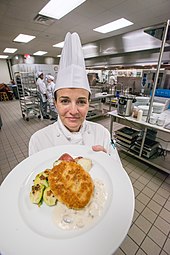
Culinary arts are the cuisine arts of nutrient grooming, cooking, and presentation of food, usually in the class of meals. People working in this field – especially in establishments such as restaurants – are unremarkably called "chefs" or "cooks", although, at its well-nigh general, the terms "culinary artist" and "culinarian" are also used. Table manners ("the table arts") are sometimes referred to every bit a culinary art.
Expert chefs are required to have knowledge of nutrient science, nutrition and nutrition and are responsible for preparing meals that are equally pleasing to the heart as they are to the palate. Afterwards restaurants, their primary places of piece of work include delicatessens and relatively large institutions such every bit hotels and hospitals.
History [edit]
The origins of culinary arts began with primitive humans roughly 2 million years ago.[1] There are various theories equally to how early humans used fire to cook meat. According to anthropologist Richard Wrangham, author of Communicable Fire: How Cooking Made The states Man,[ii] archaic humans merely tossed a raw hunk of meat into the flames and watched it sizzle. Another theory claims humans may first have savoured roasted meat past chance when the flesh of a brute killed in a wood burn was constitute to exist more than appetizing and easier to chew and digest than the conventional raw meat.
Culinary techniques improved with the introduction of earthenware and stoneware, the domestication of livestock, and advancements in agriculture. In early civilizations, the primary employers of professional chefs were kings, aristocrats, or priests. The divide between professional chefs cooking for the wealthy and peasants cooking for their families engendered the evolution of many cuisines.
A swell deal of the study of culinary arts in Europe was organized by Jean Anthelme Brillat-Savarin, a man famous for his quote "Tell me what you eat, and I will tell yous what yous are", which has since been mistranslated and oversimplified into "You are what you lot eat". Other people helped to parse out the unlike parts of food science and gastronomy. Over time, increasingly deeper and more detailed studies into foods and the culinary arts has led to a greater wealth of knowledge.
In Asia, a similar path led to a separate study of the culinary arts, which later on substantially merged with the Western counterpart. In the modern international marketplace, there is no longer a distinct carve up between Western and Eastern foods. Culinary arts students today, more often than not speaking, are introduced to the different cuisines of many unlike cultures from around the world.
The culinary arts, in the Western globe, as a arts and crafts and afterwards as a field of study, began to evolve at the end of the Renaissance catamenia. Prior to this, chefs worked in castles, cooking for kings and queens, likewise as their families, guests, and other workers of the castle. Equally Monarchical rule became phased out every bit a modality, the chefs took their craft to inns and hotels. From here, the arts and crafts evolved into a field of study.
Before cooking institutions, professional cooks were mentors for private students who apprenticed nether them. In 1879, the first cooking school was founded in the Usa: the Boston Cooking School. This schoolhouse standardized cooking practices and recipes, and laid the groundwork for the culinary arts schools that would follow.
Tools and techniques [edit]

An integral office of the culinary arts are the tools, known as cooking or kitchen utensils, that are used by both professional chefs and home cooks alike. Professionals in the culinary arts often phone call these utensils by the French term "batterie de cuisine".[three] These tools vary in materials and use. Cooking implements are made with annihilation from wood, glass, various types of metals, to the newer silicone and plastic that can be seen in many kitchens today.
Inside the realm of the culinary arts, there is a wide array of dissimilar cooking techniques that originate from various cultures and go along to develop over time every bit these techniques are shared between cultures and progress with new technology. Different cooking techniques require the utilise of certain tools, foods and heat sources in order to produce a specific desired result. The professional person kitchen may utilize certain techniques that a home cook might not, such as the use of an expensive professional grill but, cooking methods of various kinds can be found in whatsoever kitchen at virtually any point in modern human history.[4]
Professional study [edit]
Modern culinary arts students study many different aspects of food. Specific areas of report include butchery, chemistry and thermodynamics, visual presentation, food safety, human diet and physiology, international history, menu planning,the manufacture of food items (such equally the milling of wheat into flour or the refining of cane plants into crystalline sucrose), and many others.
Training in culinary arts is possible in almost countries around the world usually at tertiary level (academy) with institutions government funded, privately funded or commercial. Professional Culinary Arts Programmes (ProfCAP) are curated educational and skills studies over a 3 year menstruation with select Universities and Hotel and Culinary schools.
See too [edit]
- American Dietetic Association
- Foodpairing
- Melt (profession)
- Chef
- Cuisine
- Nutrient studies
- Fooding
- Gastronomy
- Gourmet Library and museum
- Hospitality industry
- Restaurant
References [edit]
- ^ Rupp, Rebecca. "A Brief History of Cooking With Burn". National Geographic. National Geographic. Retrieved 22 March 2019.
- ^ Wringham, Richard. Catching Fire: How Cooking Made Us Human.
- ^ Griswold, Madge. "Utensils, Cooking". Encyclopedia of Food and Civilization, edited past Solomon H. Katz, vol. 3, Charles Scribner'due south Sons, 2003, pp. 472-476. Gale eBooks. Accessed 25 Sept. 2019.
- ^ Symons, Michael. "Cooking". Encyclopedia of Food and Culture, edited by Solomon H. Katz, vol. i, Charles Scribner'south Sons, 2003, pp. 458-462. Gale eBooks. Accessed 27 October. 2019.
Bibliography [edit]
- "Cooking Schools 101". Cooking Schools. North.p., northward.d. Web. 17 September 2013
- "History". Of Culinary Athenaeum & Museum. N.p., n.d. Web. 17 September 2013
- "History of Culinary". Culinary Arts information RSS. North.p., nd. web.17 September 2013
- "History of Culinary Arts". Culinary Arts Information RSS. Due north.p,. web. 17 September 2013
- "The Culinary Timeline". The Culinary Timeline. North.p,.web. 17 September 2013
- Olver, Lynne. "The Nutrient Timeline".
Further reading [edit]
- Beal, Eileen. Choosing a career in the eating place industry. New York: Rosen Pub. Group, 1997.
- Institute for Inquiry. Careers and jobs in the restaurant business: jobs, management, ownership. Chicago: The Plant, 1977.
External links [edit]
 | Wikimedia Commons has media related to Cooking. |
 | Look upward Culinary in Wiktionary, the free dictionary. |
- U.South. Section of Labor – Food Service Managing director Information.
- Culinary Art
- U.S Department of Labor – Chefs, Caput Cooks, and Food Grooming and Serving Supervisors Information.
Source: https://en.wikipedia.org/wiki/Culinary_arts
0 Response to "How Visual Arts Is a Like to Culinary Arts"
Postar um comentário