Awesome Color Wheel Art How Do You Draw a Color Wheel Snake
I find watercolor mixing fascinating.
In my early days as a budding creative person, I would dive correct into a project and rely on intuition and a chip of luck to mix my colors. My art instructor would tell me "learn color mixing before you learn how to paint".
Did I listen ? Nope !
The results were not always very gratifying !
I would sometimes mix three or four different pigments to go the color I was hoping for. As many of you have probably discovered, when y'all mix too many watercolor paints the resulting colors tin look faded and wearisome !
So I eventually learned how to make a watercolor colour wheel.
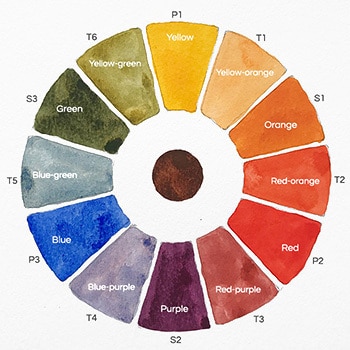
A watercolor color wheel is an of import first step towards understanding mixing.
I would encourage every watercolorist to brand their own versions. Not simply for the sheer pleasure of it, just likewise because they are a very useful guide to colour mixing.
If yous search the internet you will find a multitude of watercolor color wheels, each with their own slight variations. Notwithstanding, none of them seem to give a full and satisfying explanation of how to make a watercolor wheel, or explain its importance, and the purpose of colour wheels in art.
Making colour wheels is a lot of fun, but what's the point ? It's worth taking a few minutes to understand why you lot're making the color wheel in the get-go place.
All is revealed below !
If y'all just want to get going and brand your own color wheel you tin can spring immediately to the footstep by step instructions beneath.
The anatomy of the watercolor color wheel - Why 12 colors?
To become started, a fiddling bit of color terminology is going to be useful. You'll hear artists talk about these terms and ideas repeatedly, so getting to know the vocabulary is a good idea.
The foundation of the traditional painter's color bike is the primary color triad:
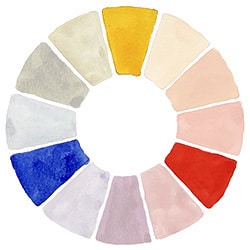
These are located at equal distances around the wheel with yellow at the top.
The primary colors cannot be mixed from any other combination of colors and are a vital add-on to your watercolor palette .
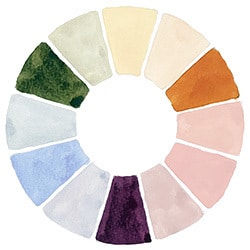
Secondary colors are achieved by mixing one master colour with another in equal amounts. For instance l% yellow and fifty% ruby = orange. There are 3 secondary colors on the color cycle, located at equal distances from each other, and the primary colors.
3rd colors are created by mixing a chief color with an adjacent secondary color. So for example yellow mixed with orangish = yellow-orange. At that place are a total of 6 tertiary colors on the color wheel, all located in the gaps between the primary and secondary colors. The naming convention for tertiary colors e'er begins with the primary colour proper name + the secondary colour name:
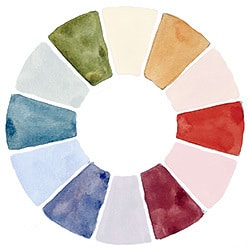
iii primary colors + 3 secondary colors + 6 tertiary colors = a 12 color bike
Agreement what colors y'all can invent with a basic color wheel gives y'all the know-how for creating diverse color relationships.
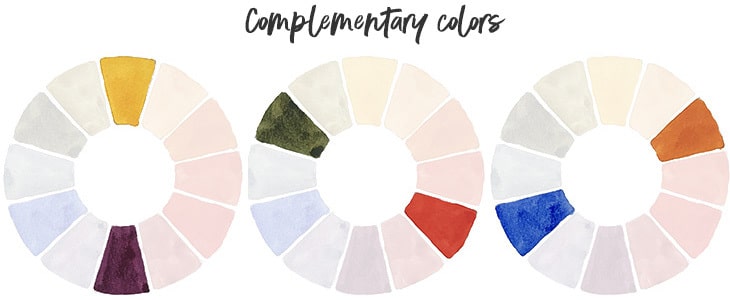
For example, colors that are directly opposite each other on the color wheel are known every bit complementary colors. When you place these colors side by side in a painting they create the strongest corporeality of contrast. Ii complementary colors will raise each other and produce vibrant and heady results. See below for a few examples.
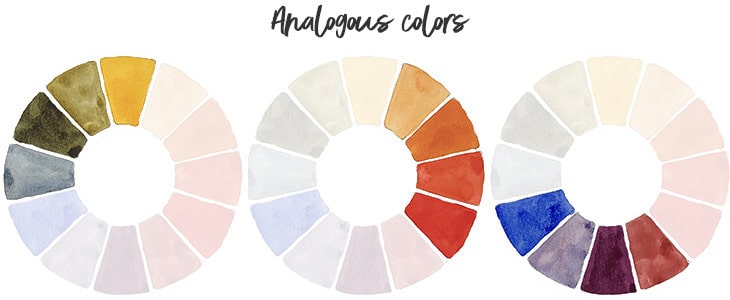
Colors that sit down side by side to each other on the color wheel create a color harmony known every bit analogous colors. These colour hues are very close and together they create smoothen and calming combinations.
You can continue to build interesting color relationships using the colour bicycle. Triadic colors for case are a set up of 3 colors equally spaced around the color wheel (forming a triangle). They tend to create a dynamic and vibrant color harmony.
What is the purpose of the color wheel ?
These colour wheels keep cropping up everywhere… Right? Then you're probably wondering why the colour cycle is so essential to artists?
A color wheel is a fundamental tool for mixing colors, and it'south a way to anticipate the results of mixing watercolor pigments together.
The basis of the colour wheel is 3 primary colors. Just with watercolor paints there is no such thing as a perfect yellow, blue or red. These "primary" paints are dependant on the pigments used to make each paint. Y'all probably have all kinds of yellows, reds and dejection in your collection. Making colour wheels with unlike combinations of primaries helps y'all to go to know the mixing possibilities of your palette!
The colour wheel will teach you how to make secondary and third colors apace, and help you expand you mixing range by quickly identifying complementary colors. Let me explain...
How to use a colour wheel to mix colors ?
Allow's take an example. Utilize the colour wheel to identify pairs of complementary colors opposite each other on the wheel.When you mix pairs of complementary colors, quite amazingly you obtain a multifariousness of different hues of browns!
You can do this past combining a primary plus a secondary color (e.g. yellowish plus purple) or pairs of tertiary colors (east.k. yellow-orange plus blue majestic). So long equally the colour hues are reverse each other on the wheel.
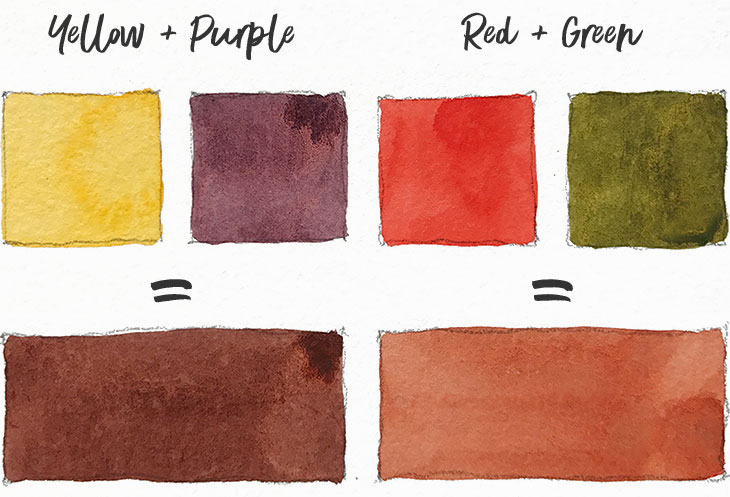
In theory y'all tin mix any hue y'all demand with three primary colors. Painting with a limited color palette like this helps create harmony in your paintings. It ways you have to work a bit harder to mix your colors, but you will larn so much about color mixing and your confidence in mixing colors will grow!
Try mixing different color combinations with your paints to find your favorites!
let the color wheel assistance you cull the paints that you mix and the guess paint proportions yous need ... then rely on your heart to become the right mixture.
I like to use a sketchbook and keep notes of the pigment names and pigments I utilize. Like this I can build up a handy reference guide for mixing watercolors.
How to make a 12 color watercolor bicycle - step by step
Y'all'll exist amazed at the variety of colors you lot can obtain simply by making color wheels with unlike combinations of primary colors. Color wheels are especially useful if y'all employ your ain personal drove of paints. You lot can feel for yourself the range of colors you can mix and utilise the wheels as a crude guide for futurity color mixing.
Supplies used :
Note that paint names differ from one watercolor make to some other. To identify equivalents in another brand of pigment, you tin try to match the pigments they incorporate in the paints I've used. I used Daniel Smith watercolors for this exercise. Here are some equivalents in other brands:
| Daniel Smith | Winsor & Newton | 1000. Graham |
|---|---|---|
| New Gamboge | New Gamboge Yellowish | Gamboge |
| Pyrrol Crimson | Winsor Red | Pyrrol Red |
| French Ultramarine | French Ultramarine | Ultramarine Blue |
By convention xanthous is always placed at the elevation of the wheel. After that, you lot'll find that red and bluish are inconsistently placed on either side of the cycle. I choose to identify red on the right for my color tests.
Refer to the paradigm beneath or print my template to use as a guide.
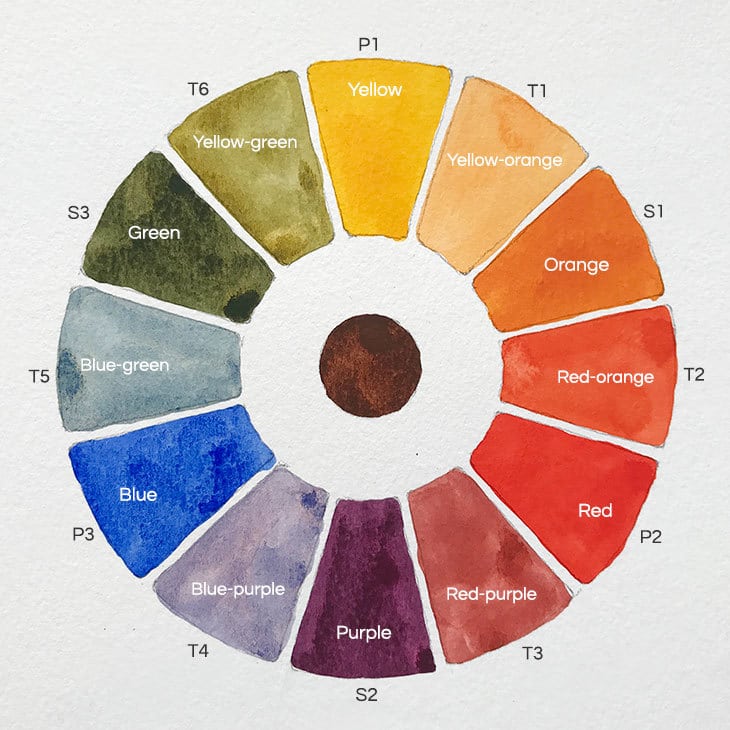
-
1
Draw the layout of your color circle onto some watercolor paper with a pencil. A lot of people apply a CD every bit a template. Y'all can use a CD, a protractor and a ruler or If yous prefer you can download my own template and trace information technology onto paper (I just use the adept old fashioned method of holding the sheets against a window to trace - I find this is quicker and easier than measuring everything ). -
2
Find a big round plate to use every bit a mixing palette. I similar this method considering you tin accommodate your paint puddles effectually the circular plate in the same locations as your color bike. (elaborate) -
3
Outset by painting the iii primary colors. Try to go along the tone of each color the same. Don't forget to clean your brush thoroughly when you lot move on to the next color. Use the positions P1, P2 and P3 indicated on my template. -
4
Side by side mix and paint the secondary colors in positions S1, S2 and S3. Brand certain to mix a large plenty pool of secondary colors and reserve some for the next stage. -
v
Lastly mix the tertiary colors and identify them in positions T1, T2, T3, T4, T5 and T6. -
6
Position C0 at the center of the color bicycle mixes the three primary colors in equal parts yellow, red and blue. This is the theoretical "black" simply which usually results in a brown or grey color depending on the pigments in your paints.
The resulting color locations should be as follows:
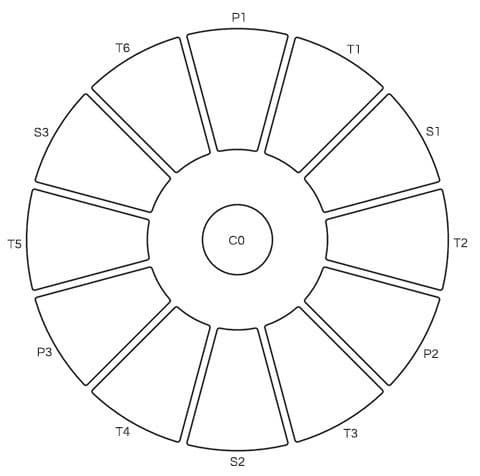
Congratulations!
You've just completed a fabulous 12 color watercolor wheel…
My colour bicycle was created using what are considered to be warm hues. Y'all can try repeating the procedure and create a colour bike using cool hues. You'll find that the results are completely different!
You might be wondering what warm and cool hues are ? For case cool blues are those that have a green bias. Warm blues take a red bias. Cool reds accept a majestic bias and warm reds have an orangish bias. Yous tin use the colour bicycle to judge the cool or warm tendency of a color.
My suggested paints for cool hues would be:
You can even try mixing a alloy of warm and cool hues for yet some other prepare of results!
Maybe try:
You'll take the most success using artists quality paints. I'm using Daniel Smith but you lot tin find first-class alternatives from Winsor & Newton or Yard Graham for case. If you lot want to play around with this same mixture of warm and cool principal colors, Daniel Smith offer a sample pack of small tubes which are ideal.
At present information technology'due south your plow ! Take fun painting some gorgeous color wheels !

Like This ? Share in on Pinterest!

Source: https://www.watercoloraffair.com/how-to-make-a-12-color-watercolor-wheel/
0 Response to "Awesome Color Wheel Art How Do You Draw a Color Wheel Snake"
Postar um comentário